The Beach in the Long Twentieth Century
Also known as: Digital Shores: An Interactive Atlas of Beach Narratives
The beach is an important space in Western literature. Ever since the rise in popularity of the seaside holiday, the beach has been depicted as a site of leisure, sensuous enjoyment and play, clearly distinguished from and often in a dialectical relationship with industrialised and metropolitan spaces of work. Despite its significance as a spatial frame in fiction, travel writing and memoirs, however, the beach has played a relatively minor role in scholarship until fairly recently. This project seeks to redress this neglect, focussing on a period in which the beach has undergone dramatic changes, both in everyday culture and in literary and artistic representations: the ‘long twentieth century,’ dating roughly from 1890 to the present. At the beginning of this period, the beach emerged as the vacation site we are still familiar with today. Twentieth-century authors chose the beach as a recurring setting to explore a specifically modern mobility that is both literal and figurative, encompassing bodily movement, travel, sexual transgression and cross-cultural encounters, as well as creativity and transformation. However, the prevalent conception of the beach as a liberating, and even paradisiacal, space mainly connoting leisure overlooks the continuous presence of violence and death, specifically the fact that beaches were theatres of war in both the First and the Second World War. If beach holidays from the 1950s onwards indicated post-war prosperity – but also, in the naming of the bikini after a site of nuclear testing, pre-war anxiety – in the last decades of the twentieth century and even more so since the millennium the paradisiacal connotations of the beach have begun to disintegrate. Natural and human-caused disasters such as tsunamis, oil spills, nuclear tests and rising sea levels as harbingers of climate change signal the fragility of littoral space. The arrival of large numbers of refugees on the European coasts of the Mediterranean has transformed the beach into a contested legal and political zone, its instability eradiating into the centres of the European Union. Extant research on the beach is mainly of two types: survey studies covering long periods, often from early modernity to the present, or articles restricted to analyses of a few authors or texts. By contrast, this project chooses a meso-level of analysis: within a sufficiently long but clearly delimited period, the subprojects provide in-depth studies of selected research areas. Close cooperation between the subprojects ensures that the archival and analytical work conducted in each is linked to a common set of questions, thus significantly contributing to the conceptualisation of the beach and littoral space.
Abstract
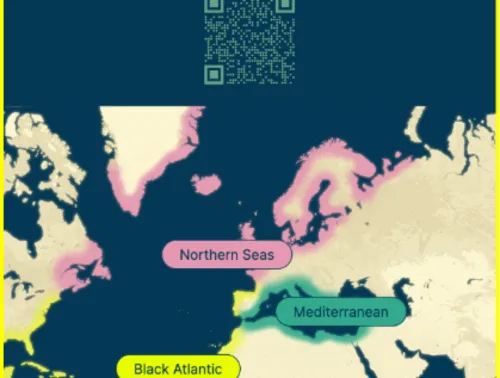
Digital Shores: An Interactive Atlas of Beach Narratives was created as a part of an SNSF project on "The Beach in the Long Twentieth Century" (100012_192810 / 1) and links the four individual projects that the team members worked on. This digital literary atlas is a visualisation of the function of the beach in (mainly) anglophone literature, published between 1890 and 2023. It foregrounds the beach not simply as a setting, but as an active element in literary texts. Littoral spaces, like shores, coasts, and beaches, enable unruliness, disturbance, and change. Encounters involving social conflict, violence, death, romance, and sex are exceptionally pervasive on the literary beach, whether they happen between humans or between humans and the more-than-human world. So are experiences of new self-awareness, renewal, and rebirth. A map displays a selection of texts – novels, short stories, and narrative nonfiction – in which the beach plays a crucial role, and the thematic and regional maps that were designed for the project visualise some of the classifications the team decided on for key topics and regions. From each of the texts in the corpus, short excerpts were chosen that showcase the function of the beach.
Type of Data
Data Languages
Data Publication Year
Keywords
Disciplines
Temporal Coverage
Spatial Coverage
Additional Material
Cite this Project
Permalink
Citation
Data Access