
Life Histories of Theban Tombs

Life Histories of Theban Tombs

Also known as: LHTT

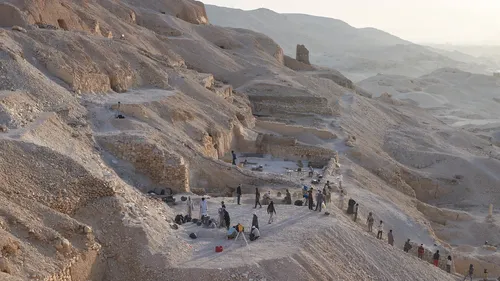
The University of Basel, Switzerland, has been conducting an overarching archaeological project on “Life Histories of Theban Tombs” (LHTT) at the ancient hillside cemetery of Sheikh ‘Abd el-Qurna (SAQ) in Western Thebes since November 2015. In cooperation with partners at the ETH and the University of Zurich and an international expert team, LHTT investigates two clusters of mostly unfinished rock-cut tombs from the beginning of the Middle Kingdom (1900–1750 BCE) and the mid-Eighteenth Dynasty (c. 1450‒1400 BCE). The latter group of tombs can be understood as part of a planned cemetery opened for a small elite with close personal links to Pharaohs Thutmose III and Amenhotep II. These tombs share a long use history. Distinction can be made between their “systemic” use, including their creation, decoration, use and reuse as sacred spaces for burials and cultic performance during Antiquity (not excluding phases of severe looting and damage), and “non-systemic” use in more recent times, notably as dwelling space for Coptic monks from the 6th to the 8th centuries CE, as well as modern villagers during the 19th and 20th centuries. The project promotes the interaction between Egyptology, archaeology, art history, philology, physical anthropology, natural and computer sciences, geomatics, and several archaeometrical fields. It also aims at analysing the emergence and life cycles of the investigated tombs in their natural and built environment. Research focuses on landscape development, including recent activities in the cemetery and in individual tombs, tomb construction and decoration practices, reception, and funerary and domestic (re)uses of the tombs over time. The archaeological site stretches over the western and central parts of the SAQ hill; it includes an area covered by a huge cone of debris (AU1000) and comprises two clusters of rock cut tombs: TT95A‒C and K85 in the west, and TT84-K453-K90-K555 in the centre of the hillside. Tomb K555 was, until recently, buried beneath debris accumulations of AU1000. It is currently being excavated (courtyard and inner halls). To the east of TT84 lie the remains of a construction site (AU6000), which were also re-excavated. The publication plan is divided in two axes. On the one hand, groups of relevant finds from the first cluster of tombs (TT95A–C and K85) are the subject of various separate articles, some of which are already published in a single volume (see Gnirs (ed.) 2021). On the other hand, the complete study of the decorative programmes of TT84 and K555 (texts and iconography), including archaeological finds from the recent excavations of K555 and area AU1000, is ongoing.

Abstract

AU1000 – AU1080 from Debris Hill (above K555); All Data from AU6000; All Data from K85; All Data from TT95

Publications

1. Sartori, M., “Tombe tebane in dialogo. TT 84, TT95 e la rete di committenti”, in Di Natale A. & Basile C. (eds.), Atti del XIX Convegno di Egittologia e Papirologia, Siracusa, 1-4 Ottobre 2020, Quaderni del Museo del Papiro XVIII, Siracuse, 2022, 47-56.
2. Hunkeler, Ch., “Fragments of a Ramesside Coffin Ensemble: What Information Can Be Gained?”, in Kilian, A., & Zöller-Engelhardt, M. (eds.), Excavating the Extraordinary. Challenges and Merit of Working with Small Finds, Heidelberg, Propylaeum, 2021, 155-180.
3. Loprieno-Gnirs, A. (ed.), Life Histories of Theban Tombs. Transdisciplinary Investigations of a Cluster of Rock-Cut Tombs at Sheikh 'Abd el-Qurna, Cairo, American University Press, 2021.
4. Sartori, M., “Die visuelle Komposition „Gard. R4” („Brot auf Schilfmatte“) zwischen schriftlicher und bildlicher Repräsentation", in Backes, B. & Serova, D. (eds.), (Un)Sterblichkeit: Schrift–Körper–Kult: Beiträge des neunten Berliner Arbeitskreises Junge Aegyptologen, Berlin, Wiesbaden, Harrassowitz, 2020, 189-200.
5. Sartori, M., “Art as Writing, Writing as Art. Case Studies from Selected New Kingdom Theban Tombs”, in Graves, C. (ed.), Proceedings of the 4th British Egyptology Congress, Manchester, London, Egypt Exploration Society, 2020, 124-134.
6. Hunkeler, Ch., “Rest in Pieces. Fragments of a Twenty-fifth/Twenty-sixth Dynasty Burial Ensemble” in Dawson, J. & Strudwick, H. (eds.), Ancient Egyptian Coffins. Past – Present – Future, Philadelphia-Oxford, Oxbow Books, 2019, 203.
7. Ziegler, M., Colldeweih, R., Wolter, A., Loprieno-Gnirs, A., “Rock Mass Quality and Preliminary Analysis of the Stability of Ancient Rock-cut Theban Tombs at Sheikh ‘Abd el-Qurna, Egypt” in Bulletin of Engineering Geology and the Environment, 2019, 1–27.
8. Loprieno-Gnirs, A., “Creuser une tombe dans la colline thébaine : le projet archéologique Life Histories of Theban Tombs de l'université de Bâle" in Bulletin de la société française d'égyptologie 199, 2018, 100–126.
9. Friedli, E., Banz, J., Gojcic, Z., Wieser, A., “Fusion of Laser Scanning and Photogrammetric Data for the Documentation and VR Visualization of an Archaeological Tomb Complex” in FIG 2018, Embracing our Smart World where the Continents Connect Proceedings, Istanbul, Copenhagen, International Federation of Surveyors (FIG), 2018.
10. Underwood, M., “Domestic Occupation of Theban Tomb 95 in the First Millennium AD” in Di Biase-Dyson, C. & Donovan, L. (eds.), The Cultural Manifestation of Religious Experience. Studies in Honor of Boyo G. Ockinga, Münster, Ugarit Verlag, 2017, 225–240.

Cite this Project

Citation

Life Histories of Theban Tombs (2023). DaSCH. https://ark.dasch.swiss/ark:/72163/1/0820

Data Access

Access Rights
Embargoed Access
License
Creative Commons Attribution-NonCommercial 4.0 International License
(2023-12-06)

Copyright

Life Histories of Theban Tombs

Contact

Professor of Egyptology, Professor (Chair of Egyptology)
University of Basel
University of Basel, Department of Ancient Civilisations
s.bickel@unibas.ch

Project Timeline

Period
2015-11-01
Status
Ongoing

Funding

Grants
Swiss National Science Foundation (SNSF)
Grant: 162967
Project Funding
More info
Data Management Plan
Not accessible